Receipt Number on a Store Receipt: Where to Find It

Sarah Jenkins
Content Writer
Jump to Section
Written by Sarah Jenkins, Content Writer. Reviewed by the BuildReceipts Editorial Team. Updated September 5, 2026.
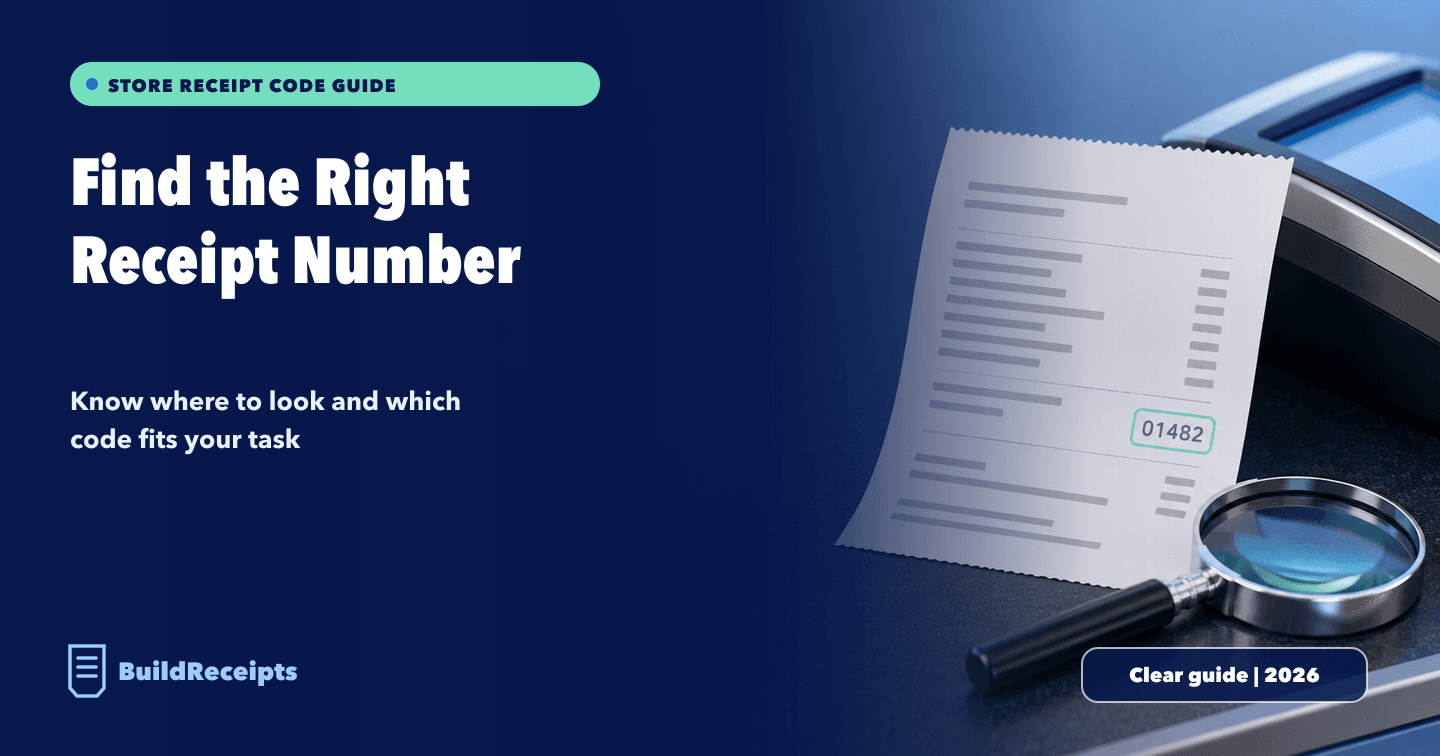
A receipt number is a code for one sale in a store's system. It is often near the top or bottom of the receipt. Look for Receipt #, Receipt ID, Trans #, Transaction ID, Ref #, or TC #.
There is no one label or spot used by every store. A restaurant may use Check #. A hotel may use Folio #. An online order may show Order # or Confirmation #. The right code depends on your task.
Use the steps below to find the best code for a return, work claim, or receipt lookup. Do not post a full receipt online. It may show private facts.
What is a receipt number?
A receipt number is a code tied to a payment or sale. The seller may use it to find the sale, send a copy, check a return, or match its records.
The code may use numbers, letters, or both. It may be short, like 01482. It may also have parts for the store, register, date, and sale. Each checkout system can use its own style.
Where is the receipt number on a store receipt?

Check these places first:
- Under the store name, address, date, and time near the top.
- Near the payment block or total in the lower half.
- Just above or below the barcode at the bottom.
- In the subject line or details of an email receipt.
- Beside the order summary in a store app or online account.
Do not pick the longest number just because it looks important. A barcode, item SKU, approval code, or card digits may be close by. Read the label. Think about your task.
If you are learning the full layout, this guide to what an itemized receipt shows explains the item, tax, and payment sections around the code.
Common receipt labels and what they mean
| Label | Usual meaning | Common use |
|---|---|---|
| Receipt # or Receipt ID | Code for the receipt or sale | Seller lookup or copy |
| Trans # or Transaction ID | Code for the payment event | Payment search or support |
| Order # | Code for an online or pickup order | Order tracking and service |
| Ref # | Internal or payment reference | Support and matching |
| Check # | Restaurant bill number | Restaurant lookup |
| Folio # | Hotel stay bill number | Hotel billing help |
| Store, Register, or Terminal # | Place or device that made the sale | Helps narrow a lookup |
| Invoice # | Code for an invoice | Billing records, not always the receipt |
One receipt can show many codes. Each may help the seller. They do not always mean the same thing.
How to find the right receipt number in four steps
Step 1: Decide what you need
For a store return or receipt copy, start with Receipt #, Receipt ID, TC #, or Transaction ID. For an online order, start with Order #. For a hotel bill, use the folio number.
Step 2: Scan the top and bottom
Read the top area under the store details. Then check near the total and barcode. In an email, search for “receipt,” “transaction,” “order,” or “reference.”
Step 3: Match the label, date, and total
Pick a code for the whole sale, not one item. Check that the date and total match your buy. An item SKU can show on many receipts. It is not the sale number.
Step 4: Give the seller the full lookup set
When you call the store, share the date, place, total, and way you paid. Give the last four card digits only if the seller asks. Add the receipt or sale code you found. Never send a full card number by email or chat.
If the paper is gone, follow the lost receipt recovery steps before trying to make a new record. The seller's duplicate is the best source when one is available.
Receipt number vs other numbers

| Number | What it points to | Is it always the receipt number? |
|---|---|---|
| Receipt number | The receipt or completed sale | It is the main code when labeled that way |
| Transaction number | A payment event | No, but some systems use it for lookup |
| Order number | An order placed online or in an app | No, one order may have more than one payment |
| Invoice number | A bill asking for payment | No, an invoice can exist before payment |
| Approval code | Card payment approval | No, it is a payment-network code |
| SKU or UPC | One product | No, it identifies an item, not the sale |
| Last four card digits | Part of the payment card number | No, but it can help a seller search |
If “invoice” and “receipt” feel mixed together, read the simple invoice and receipt comparison. It shows why the two papers can carry different numbers.
What does a receipt number look like?
The examples below are made-up formats. They show common shapes, not real store rules.
| Example | What the parts might mean |
|---|---|
| 01482 | A simple sale sequence |
| R-2026-01482 | Receipt, year, and sequence |
| 104-07-01482 | Store, register, and sale |
| WEB-A7K29P | Online channel and order code |
Do not try to change or invent a code to make a document look official. A real merchant number comes from the merchant's own system.
Why does the receipt number matter?
It can help the seller find the exact sale among many payments with the same total. It may speed up a copy request, return review, warranty question, or expense check. Businesses can also use unique numbers to keep their own records in order.
The number alone may not be enough. A seller may ask for the date, store, total, item, email, phone, or payment facts. Store rules decide if the sale can be found. The store also decides what proof it accepts.
What if the number is missing or faded?
Start with your email, texts, store app, and online account. Search the seller name and date. If you paid by card, the date and amount on your statement may help the store search. A statement is not an itemized receipt.
Take a clear photo if part of the paper can still be read. You may raise the photo contrast, but do not change the facts. Then call the seller. Share the store, date, rough time, total, items, and payment type. The seller may be able to print or email a copy.
If a code was cut off, keep the whole paper. Store, register, terminal, and cashier details may still help support find the right sale.
Is the last four-digit card number the receipt number?
No. The last four digits show part of the card used. They can help a seller narrow a search, but they do not name the receipt.
US rules limit what a printed card receipt can show. The FTC says a customer copy must not print more than the last five card digits. It must not show the card end date. This helps keep card data safe. Cover private facts before you share a receipt.
How BuildReceipts can help
BuildReceipts can help you make a clear custom record for a real sale. Use it only when you know the true facts. Add your own receipt number, date, seller, items, tax, total, and payment type. Check the file before you download it.
The tool cannot look inside a store's system or get its official number. A custom document is not an official merchant receipt. It is not a valid stand-in when a store, tax office, insurer, employer, or warranty team asks for an original or store copy.
The bottom line
Look near the top, total, payment block, or barcode for a label. Then match the code to your task. Receipt ID often helps with a store lookup. Order # is for an online order. Folio # is for a hotel bill.
When in doubt, give the seller the date, store, total, payment type, and code you found. The seller can tell you which number its system uses.
Sources
Frequently Asked Questions
Have more questions about Receipt Number on a Store Receipt: Where to Find It? Check out these common queries.