Bank Statement vs. Receipt for Taxes: What Each Record Proves

Sarah Jenkins
Content Writer
Jump to Section
A bank statement can show the vendor, date, and amount paid. A receipt or paid invoice can show what you bought. For a business deduction, you may also need a note that explains the business purpose.
Payment proof and expense proof are related, but they are not always the same record. Use the comparison below to spot the gap. This is general US recordkeeping information, not tax advice.
Can a Bank Statement Replace a Receipt for Taxes?
Sometimes a statement is useful evidence, but there is no simple rule that makes it a full receipt. The IRS says taxpayers must keep records that support the income, deductions, and credits on a return.
Useful records should show five facts: who was paid, the amount, the date, what you got, and proof of payment. One paper may not show them all.

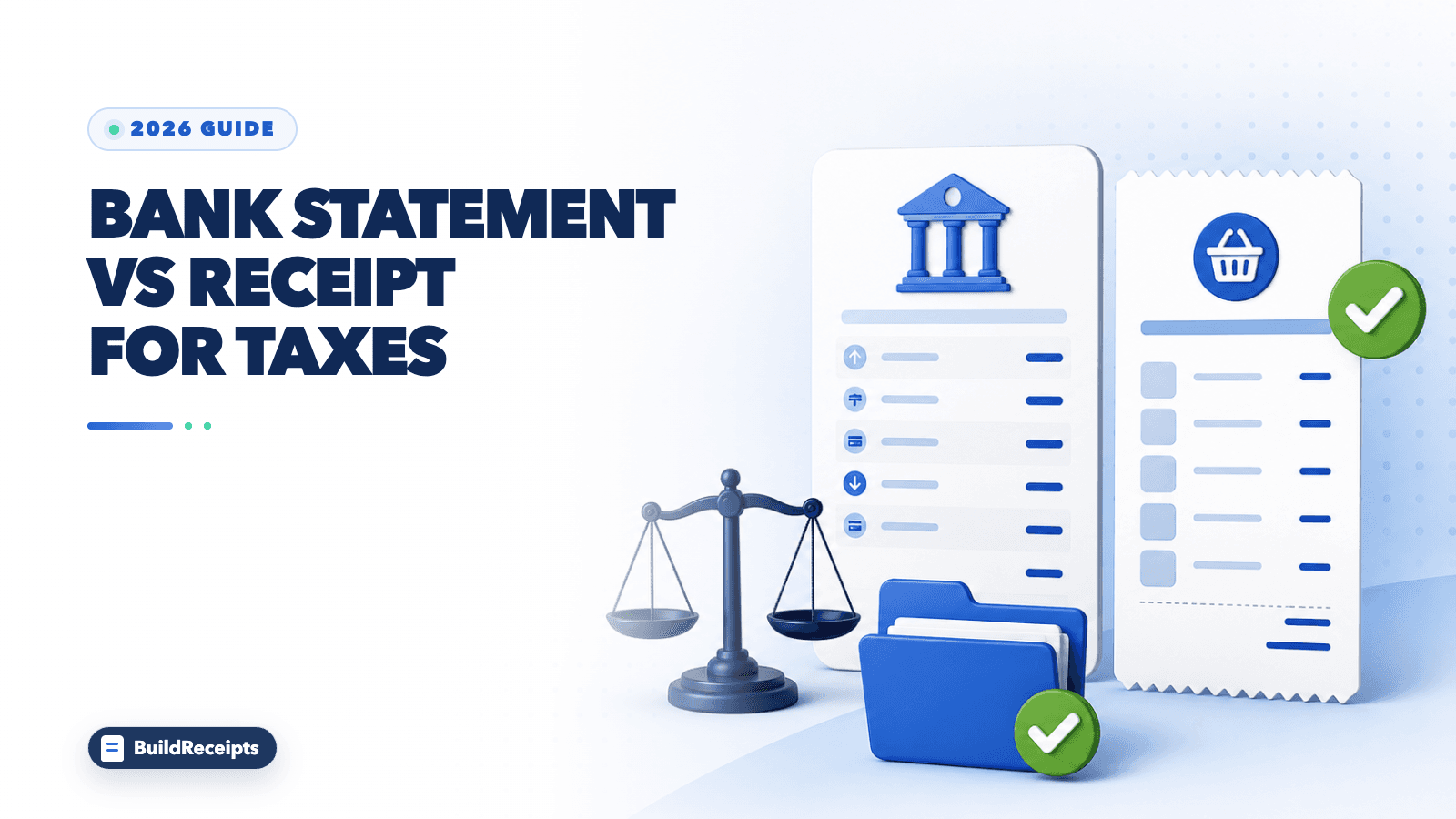
Bank Statement vs. Receipt: Quick Comparison
| Record | Usually proves | Often does not prove |
| Bank or card statement | Merchant, posted date, and amount paid | Items, tax, quantity, and business reason |
| Itemized receipt | Seller, date, items, tax, and total | Whether a later refund changed the payment |
| Paid invoice | Itemized charge and completed payment | Business purpose unless you add it |
| Order history | Order details and status | Final card settlement in every case |
A bank date can differ from the store date. Merchant names can also be shortened or use a parent company name.
What a Bank Statement Proves
A statement can support a real expense when it matches another record. For example, pair a contractor invoice with the bank transfer, or pair an order email with the card charge.
It can also help find a lost purchase. The date, merchant, and total give the seller details to search.
The statement is stronger when the merchant name is clear and the amount matches the itemized record exactly.
Why Payment Alone May Not Prove a Deduction
A statement line such as "$84.27 - STORE" does not name the items or explain their business use. The IRS recordkeeping guide says a mix of documents may be needed to support all parts of an expense.
Meals, travel, gifts, lodging, and vehicle expenses can have added substantiation rules. Keep time, place, amount, business purpose, and any other required detail.
A later refund can also change the real cost. Keep the refund record with the first charge.
What Records Can Support a Business Expense?
IRS guidance lists many useful records. These include account statements, card statements, checks, receipts, and invoices. You may need more than one record.
What an Itemized Receipt Proves
Use a seller-issued receipt for a paid sale. An invoice is useful when it shows the items and services. Look for paid, a zero balance, or matching payment proof.
Canceled Checks and Account Statements
These can prove payment. Keep both sides of a canceled check when available, plus the bill or invoice it paid.
Order History, Emails, and Business Notes
Save the final order page, not only a cart or early confirmation. Add a short, timely note about the business purpose when the document does not explain it.
The IRS receipt requirements guide gives a broader list of records and common retention periods.
How the $75 Rule Actually Works
The under-$75 exception in IRS Publication 463, chapter 5 applies to covered expenses, not all business spending. It does not remove the need for an expense record.
Lodging generally needs documentary evidence even below $75. Separate rules cover qualifying employer per diem methods and transportation for which a receipt is not readily available. Check the rule for your expense rather than assuming "under $75" means no proof.
What to Do If a Tax Receipt Is Lost

Step 1: Ask the seller for a duplicate or digital receipt.
Step 2: Search email, order history, and account records.
Step 3: Match the bank or card payment.
Step 4: Add shipping, warranty, calendar, mileage, or business-purpose records when relevant.
Step 5: Write a truthful note about what is missing and how the amount was checked.
The proof-of-purchase guide shows how to combine records without mislabeling them.
Record-Matching Examples
These are illustrative cases, not real customer records or a ruling on deductions. Start with the payment line. Then check the item details and business purpose.
Office Supplies: Separate the Personal Item
| Record | What it shows |
| Bank line | $84.24 paid to Office Shop |
| Seller receipt | Paper $50 + toner $25 + personal snack $3 + tax $6.24 = $84.24 |
| Business note | Paper and toner for the design office; snack excluded |
| Gap to resolve | Use the receipt tax lines or applicable allocation rules to separate business tax. Do not claim the full mixed total. |
Client Meal: The Card Total Is Not the Whole File
| Record | What it shows |
| Bank line | $60 paid to Example Cafe |
| Itemized receipt | Food $45 + tax $5 + tip $10 = $60 |
| Business note | Lunch with Example Client to discuss the draft project; list attendees and date |
| Gap to resolve | Without item detail and business purpose, the payment alone leaves facts out. The deductible amount depends on the meal rules, not just the $60 paid. |
Software: Match the Charge to the Service Period
| Record | What it shows |
| Bank line | $24 paid to Example Software |
| Paid invoice | One $24 monthly plan; invoice S-104; service dates shown |
| Business note | Used to schedule client projects |
| Gap to resolve | Check refunds, credits, personal use, and the tax year. A statement alone may not show which service period the charge covers. |
Keep these as linked files, not a new receipt made to look seller-issued. If a fact is missing, ask the seller for it and keep your request.
Tax Documentation Checklist
Check the seller, purchase date, amount, items or service, payment proof, and business reason. For a mixed sale, mark personal items. Keep later refunds and credits with the charge. Add travel or attendee details when the expense rules require them.
Keep the original file unchanged. If you add a note, make it separate and date it.
How Long Should You Keep the Records?
The IRS record-retention guidance gives different periods by situation. Three years after filing is common, but refund claims, omitted income, employment taxes, assets, and other cases can need longer. Do not use one period for every file.
State rules and the type of record can change that period. Property, job tax, loss, and late-return records may need more time. Check IRS guidance and ask a tax pro about your case.
The guide to organizing receipts for taxes can help you keep the files readable and searchable.
How BuildReceipts Can Help, and Its Limit
BuildReceipts can place true sale facts in a personal business record. Start with the receipt tools and choose the type that matches your source. The new file does not replace a seller-issued receipt. BuildReceipts also cannot promise that the IRS, a boss, or an auditor will accept it.
If you use a receipt tool, enter only facts supported by the bank record, invoice, email, or other source. Label the result as a personal record or reconstructed copy and keep every source with it.
Do not invent a sale or change an amount. Do not hide a refund. Never say the seller checked a file when it did not.
Conclusion
Use a bank statement as payment support, not as a complete itemized receipt. Pair records when one file leaves facts out. If something is lost, recover the seller copy first and rebuild the file with honest evidence.
Important: This article provides general US recordkeeping information. It is not tax or legal advice.
Primary Sources
- IRS: What Kind of Records Should I Keep?
- IRS: Burden of Proof
- IRS Publication 463: Travel, Gift, and Car Expenses
- IRS Publication 583: Starting a Business and Keeping Records
- IRS: How Long Should I Keep Records?
- Content updated September 18, 2026. Source checks and edits were AI-assisted. No new human or professional review is claimed.
Frequently Asked Questions
Have more questions about Bank Statement vs. Receipt for Taxes: What Each Record Proves? Check out these common queries.