IRS Receipt Requirements: What to Keep and for How Long

Sarah Jenkins
Content Writer
Jump to Section
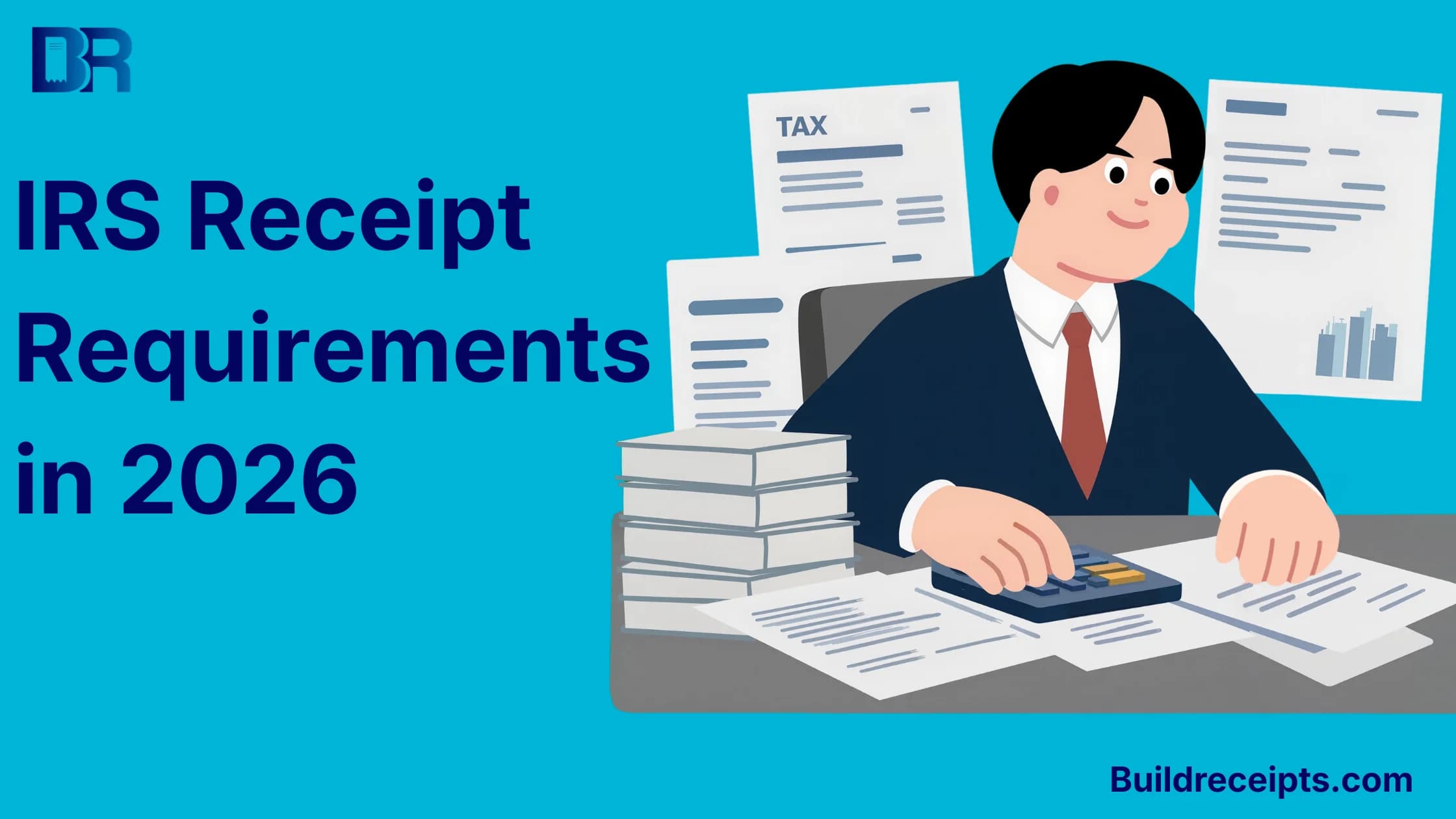
The IRS does not require one special receipt design for every business expense. Your records need to support your return. Keep the seller, date, amount, payment proof, and details that explain the business cost.
A receipt may be only one part of that file. You may also need an invoice, bank record, mileage log, attendee list, or short note about the business purpose.
This guide covers US federal recordkeeping. It is general information, not tax advice. Ask a qualified tax professional about large, unusual, or mixed-use expenses.
IRS Receipt Requirements: The Short Answer
The IRS does not require one special receipt template for every business expense. What it does require is enough documentation to support the numbers on your tax return.
The IRS business recordkeeping guide explains the basic supporting details. One record may not show them all. For travel, meals, gifts, and car costs, check the extra rules in Publication 463.
The easiest way to think about it is simple: a receipt should help answer four questions.
| Question | What your record should show |
| What did you buy? | Item, service, vendor, or expense description |
| When did it happen? | Transaction date or service date |
| How much did you pay? | Total amount, tax, tip, or separate charges when needed |
| Why was it business-related? | Business purpose, client, project, trip, or reimbursement reason |
A credit card statement can help prove payment, but it often does not show what was purchased. That is why itemized receipts, invoices, and written business-purpose notes matter.
If you are not sure what itemization should look like, this guide to itemized receipts explains the difference between a simple payment receipt and a line-by-line receipt.
What a Business Expense Record Should Show
A strong business receipt is clear enough that someone else can understand it without asking you to remember the day.
At minimum, the receipt or supporting record should show:
1. Vendor or payee name
2. Transaction date
3. Amount paid
4. Proof of payment
5. Description of the item or service
6. Business purpose when it is not obvious
For some purchases, you may need more. A restaurant receipt should show the restaurant name, location, number of people served, date, and amount. If anything other than food and beverages was charged, the receipt should show that too.
A hotel receipt should separate lodging from meals, phone charges, parking, or other costs. That matters because the tax treatment may not be the same for every charge on the bill.
For vehicles, a gas receipt alone is not a mileage record. If you use the standard mileage method, your mileage log is usually the main record. If you use actual expenses, then gas, repairs, insurance, registration, and maintenance receipts become more important.
Use the IRS mileage rate for the date of each trip, not a rate copied from an old article. The IRS table now lists 72.5 cents per business mile for January through June 2026 and 76 cents for July through December 2026, checked September 18, 2026. Keep trip dates, destinations, business purpose, and miles. A fuel receipt alone is not a mileage log.
The IRS $75 Rule and Its Exceptions
The under-$75 exception is part of the travel, gift, and car expense rules in IRS Publication 463, chapter 5. It is not a rule that all small business costs need no proof.
For covered expenses other than lodging, receipts or similar documents generally are not needed below $75. You still need records of the amount, date, place or description, and business purpose. Exactly $75 is not below $75.
Lodging and Per Diem Rules
Lodging generally needs documentary evidence even below $75. Keep the full hotel folio. A separate exception can apply when meals or lodging are accounted for to an employer under an accountable plan using a qualifying per diem method. Check that method's rules before relying on it.
Transportation Without a Receipt
Publication 463 also gives an exception when a transportation receipt is not readily available. Keep a timely trip record. An employer can set its own receipt rules, so check those too.
Record Requirements by Expense Type
Different expenses need different levels of detail. Some are easy to prove with a simple invoice. Others need extra notes because they can look personal if the business reason is not clear.
| Expense type | What to keep | Why it matters |
| Business meals | Itemized restaurant receipt, attendees, business purpose | Card slips show payment, but not always what was bought |
| Lodging | Full hotel folio with separate charges | Lodging usually needs documentary evidence regardless of amount |
| Airfare and travel | Booking confirmation, receipt, itinerary, business purpose | The record should connect the trip to business |
| Parking, tolls, taxis | Receipt, app history, statement, or trip log | Small charges still need context |
| Office supplies | Store receipt or invoice with item details | Itemization helps when stores sell personal and business items |
| Software subscriptions | Invoice, email receipt, payment proof | Shows service, billing date, and business use |
| Contractors and services | Invoice, contract, proof of payment | Explains what service was provided |
| Equipment and assets | Purchase invoice, payment proof, date placed in service | Helps with depreciation, basis, and later sale records |
| Cash purchases | Receipt or written note with backup proof | Cash is harder to verify without a same-day record |
For a mixed purchase, mark the business items and retain the full seller record. A newly made receipt layout does not replace that source.
Are Digital or Scanned Receipts Accepted?
The IRS cares more about the information in the record than whether it started on paper or online.
A valid receipt or supporting document should help prove the vendor, date, amount, proof of payment, and what was purchased. Depending on the expense, you may also need the business purpose, attendees, destination, or mileage details.
Digital receipts can count if they are accurate, readable, and available when needed.
IRS Publication 583 on electronic records says the storage system must keep complete, accurate records that can be found and reproduced clearly. A scan is not automatically enough: it must still support the expense. Keep paper originals unless your system meets the IRS rules for replacing them.
Digital records are often better than paper receipts because many thermal receipts fade. A clear PDF or scan saved right away is much easier to use than a pale receipt photo six months later.
Common acceptable records include emailed receipts, scanned paper receipts, photos of receipts, paid invoices, app receipts, bank statements, credit card statements, canceled checks, and written logs. The strongest proof usually combines payment evidence with item details and business context.
A strong receipt record should explain both payment and business purpose.
Good digital receipt habits are simple:
1. save the receipt the same day
2. use a clear file name
3. keep business and personal records separate
4. store receipts by year and category
5. keep related emails, invoices, and statements together
For a fuller workflow, this guide on organizing receipts for taxes is a useful next step.
Is a Bank Statement Enough?
A bank statement helps, but it is often not enough by itself.
The IRS burden-of-proof guidance says you need evidence for the expense. A bank statement can show payment without showing the items or business purpose. Our bank statement vs. receipt for taxes comparison shows how to pair the records.
Here is the difference:
| Record | What it proves well | What it may miss |
| Bank statement | Payment, date, vendor, amount | Item details and business purpose |
| Credit card receipt | Payment and total | Item details |
| Itemized receipt | Items, prices, tax, total | Business purpose if not obvious |
| Invoice | Service or product details | Final payment unless marked paid |
| Written note | Business purpose and context | Payment unless paired with proof |
The strongest record often uses more than one document. For example, a bank statement plus an itemized receipt plus a short business-purpose note is much better than a statement alone.
What to Do When a Receipt Is Lost
A lost receipt does not automatically mean the expense is gone, but it does mean you should rebuild the record carefully.
Start by checking email, store accounts, app order history, and loyalty accounts. Then contact the seller with the date, amount, location, and payment method.
If no seller copy is available, gather honest supporting records and write down what is missing. Explain when the note was made. Publication 463 covers incomplete or destroyed records; acceptance depends on the expense and evidence. Do not invent item details or backdate a personal note.
For a step-by-step recovery path, read lost receipt? What to do next. It covers how to rebuild proof without guessing.
How Long to Keep Tax Records
Use the IRS retention rules for your situation, not one seven-year rule for every file. These are federal periods. Other tax, insurance, or contract needs may be longer.
| Situation | Federal retention guidance |
| Usual income-tax records | Generally 3 years after filing; early returns count as filed on the due date |
| Credit or refund claim after filing | 3 years from the original filing or 2 years after paying the tax, whichever is later |
| Unreported income over 25% of gross income shown | 6 years |
| Claim for bad debt or worthless securities loss | 7 years |
| No return, or a fraudulent return | Indefinitely |
| Employment tax records | At least 4 years after the tax is due or paid, whichever is later |
| Property or equipment | Through the tax limitation period for the year of disposal; keep basis and improvement records |
Do not discard an asset receipt just because the purchase was years ago. You may still need it to work out the cost basis or a later sale.
Business Expense Documentation Checklist
Start with the seller record, then fill the gap it leaves. This checklist organizes evidence; it does not decide whether a cost is deductible.
| Situation | Keep first | Add when needed |
| Office purchase | Itemized receipt or paid invoice | Payment record and business-purpose note |
| Business meal | Itemized restaurant receipt | Who attended and the business purpose |
| Hotel | Full itemized folio | Trip purpose and itinerary |
| Vehicle cost | Mileage log or actual-cost records | Dates, destination, purpose, and relevant receipts |
| Lost receipt | Seller duplicate or completed order history | Payment record and a dated note about the gap |
If you want a readable personal summary, BuildReceipts can format verified details. It cannot issue a merchant's official copy, verify an expense, or guarantee a deduction. Keep every source file and label your summary as a personal record.
Step 1: Gather the Source Records
Find the seller receipt, invoice, payment, and business-purpose note.
Step 2: Match the Facts
Check dates, item details, refunds, and totals. Leave unknown facts marked unknown.
Step 3: Note Any Gap
Write what is missing and when you asked the seller for help. Do not claim the seller issued your note.
Step 4: Save the Whole File
Keep the sources and any personal summary together. The sources, not the layout, support the expense.
Common IRS receipt mistakes
Most receipt problems come from missing context, not from complicated tax rules.
| Mistake | Why it causes problems | Better habit |
| Keeping only a card slip | It shows payment, not what was purchased | Save the itemized receipt too |
| Waiting until tax season to add notes | Memory gets weaker over time | Add the business purpose the same day |
| Mixing personal and business items | It makes the deduction harder to explain | Separate purchases or mark business items clearly |
| Relying on the under-$75 rule too much | The rule does not remove all recordkeeping duties | Keep a simple record for every business expense |
| Saving faded paper receipts only | Thermal paper can become unreadable | Scan or save a digital copy |
| Using vague file names | Receipts become hard to find | Name files by date, vendor, and purpose |
| Recreating receipts without proof | It can look unreliable | Keep backup records with any replacement copy |
The safer habit is boring but effective: save the receipt, add context, and keep it where you can find it.
When to Ask a Tax Professional
Get help if you have weak records, a large cost, mixed personal and business use, an audit notice, or an expense with special rules. No qualified tax review of this update is claimed.
Conclusion
IRS receipt requirements are not about having perfect paperwork for every small purchase. They are about keeping enough proof to support the expense if someone asks later.
For most business expenses, aim to keep the vendor, date, amount, proof of payment, description, and business purpose. For lodging, meals, travel, vehicles, assets, and mixed-use purchases, keep stronger records.
The $75 rule is real, but it is not a free pass. Good records still matter, and digital receipts are often the easiest way to keep them clean.
If you use BuildReceipts, use it for real transactions, clear documentation, and organized PDFs. That is where it can help most.
Content updated September 18, 2026. Source checks and edits were AI-assisted. No new human or professional review is claimed.
Frequently Asked Questions
Have more questions about IRS Receipt Requirements: What to Keep and for How Long? Check out these common queries.